
This analysis has been reviewed for compliance with the latest technical SEO standards and audited for absolute factual accuracy by Elena Andreou, Deep Tech Diplomate.
As a business owner, you are the decision-maker, but you aren’t a programmer or a technical SEO engineer. When you hire an agency to redesign your website or optimize your search rankings, you have to rely on their “case studies” as proof of their competence.
Unfortunately, there is a massive gap in the digital industry between cosmetic marketing (making a site look pretty) and technical execution (ensuring the site actually drives business results).
When agencies hide behind sophisticated, academic-sounding jargon, it is easy to get swept up. But if you don’t know how to verify their claims with raw data, you risk paying thousands of euros for a beautiful, hollow shell that silently breaks your lead pipeline.
Below is a step-by-step guide on how to audit a digital agency’s claims, using real-world side-by-side evidence from a corporate recovery project.
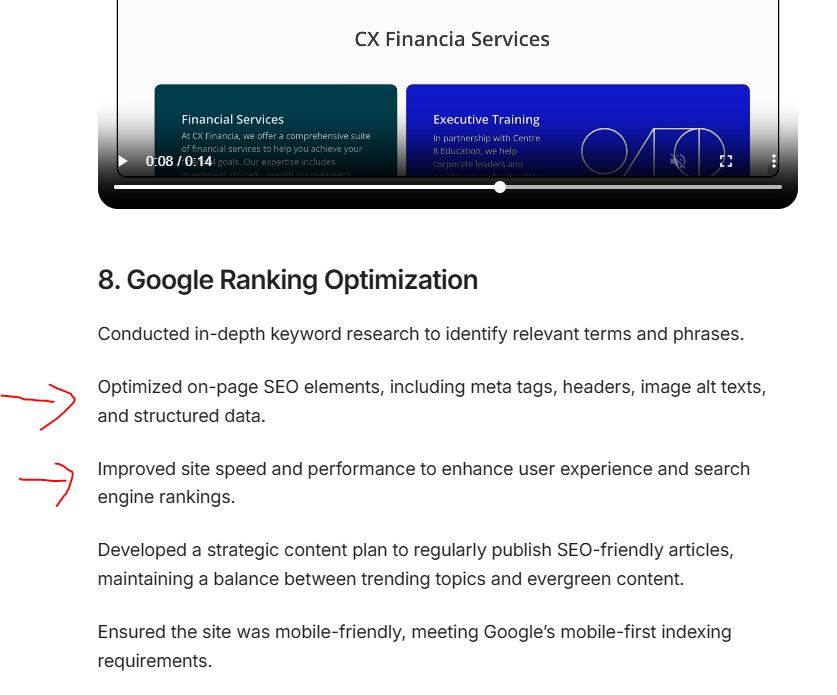
Many agencies will promise that they optimized every on-page element, meta tag, and structured data point, claiming an immediate boost in site speed and rankings.
The claim: “Optimized on-page SEO elements… Improved site speed and performance to enhance search engine rankings.”
Never rely on a text-only claim. Ask to see the native, raw performance metrics from Google Search Console (GSC) before and after the launch. If their “optimization” was successful, organic visibility should remain stable or grow.
If they failed to preserve your historical search equity, the results will look like this:

Before the Redesign (May 2024)
428 clicks / 20.1 K Impressions
A healthy, stable organic search baseline
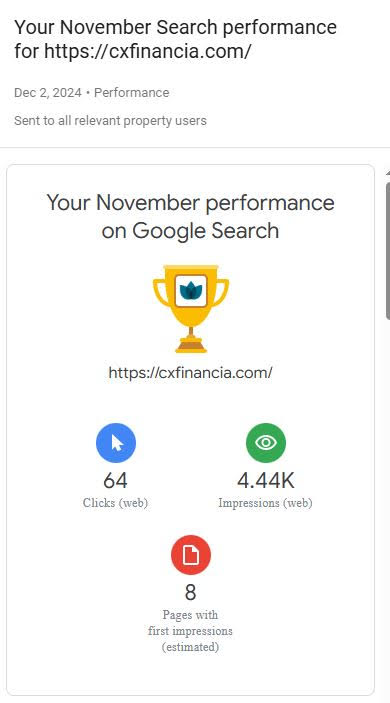
After the Redesign (Nov 2024)
64 Clicks / 4.44 K Impressions
An 85% drop in business leads post-launch
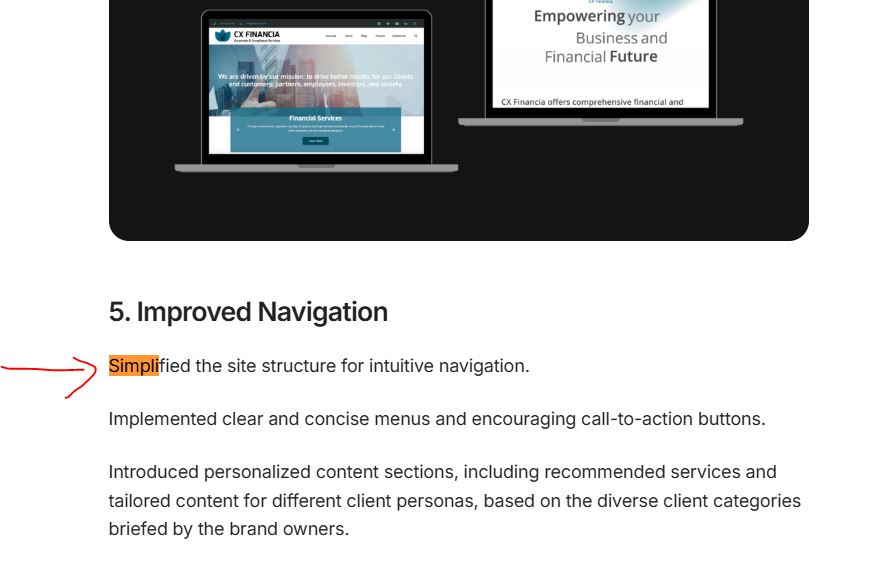
Agencies love to boast about “simplifying the site structure” and reorganizing your menu items to create an “intuitive” user journey.
The claim: “Simplified the site structure for intuitive navigation.”
When you “simplify” a website, you must map every single old web address (URL) to its new location using 301 redirects.
If an agency deletes your old pages without setting up redirects, Google will try to crawl those pages, hit a dead end, and drop your site from search results entirely.
To verify if your simplified navigation is a success or an architectural disaster, look at the Indexing Report in your Google Search Console:
The Technical Audit Evidence: 1,333 pages left unindexed compared to only 122 indexed pages.

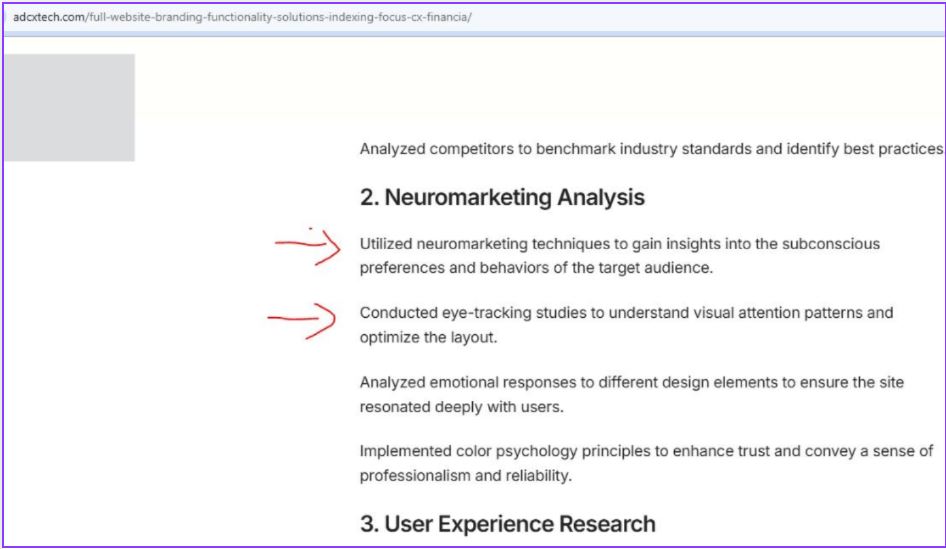
To justify premium pricing, agencies often use highly complex, pseudo-scientific terms like “neuromarketing analysis,” “subconscious eye-tracking,” and “advanced analytics tools to track user behavior.”
Claiming eye-tracking, subconscious insights, and emotional response mapping.
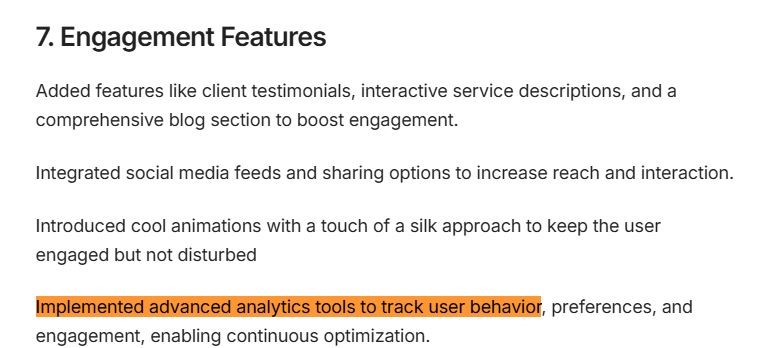
Engagement Features: Claiming “advanced analytics… enabling continuous optimization,” client testimonials, and a blog section to boost engagement.
The Visual Novelties: Introducing cool animations with a touch of a “silk approach” (a phrase we are still trying to understand from an engineering standpoint)..
A beautiful review or testimonial written as plain text on a page means nothing to a search engine. To turn testimonials into an SEO ranking signal, they must be deployed using Review Snippet Schema (Structured Data). Without this behind-the-scenes technical code, Google has no idea those reviews exist, and they will never show up as star ratings in search engine results.
Furthermore, tracking code is completely useless unless it funnels directly into your bottom line. Setting up tracking script without actionable CRM flows is the definition of E-commerce Technical Debt: paying for data you don’t use.
When you look at a truly functional technical deployment, you will see explicit structured data confirmation directly inside your Google Search Console under the Enhancements tab:
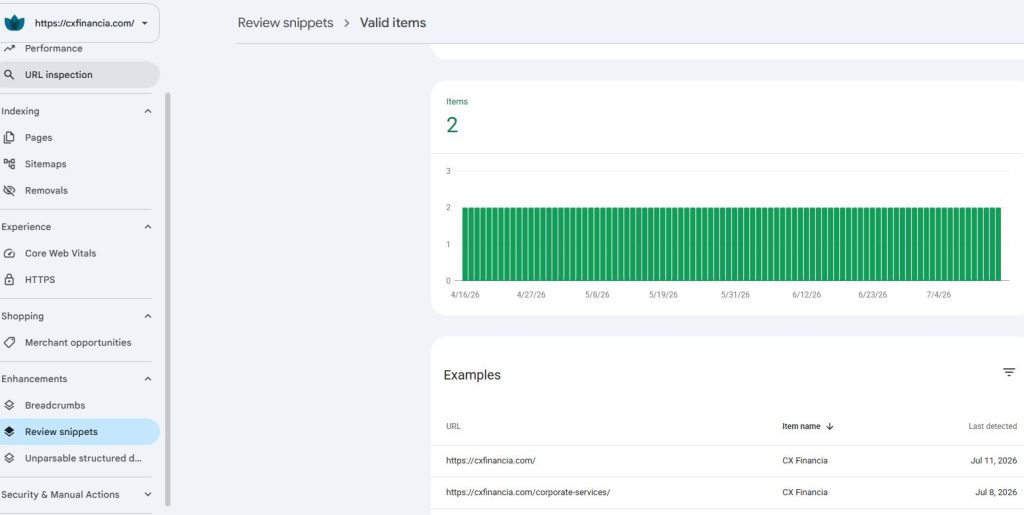
The Technical Audit Evidence: True technical execution showing 2 valid, structured Review Snippet items successfully indexed in July 2026.
The Diagnostic Reality: The previous redesign agency pasted basic text on a page and called it an “engagement feature,” completely missing the structured data required for Google indexation. Additionally, while analytics code was technically loading, it was a completely disconnected data graveyard. True advanced tracking means a user’s action (like adding a service or dropping off) automatically alerts your sales pipeline, instead of remaining empty telemetry.
What to ask them:
“Can you show me the Review Snippets report in Google Search Console to prove our testimonials are properly structured and indexed by Google?”
(You can also independently perform the test on the official Google Rich Results Test.
When we develop or optimize a digital property, we do not stop at visual formatting. Search engines do not rank websites based on how “pretty” they are; they rank them based on machine-readable entity architecture.
Every client under our care receives a complete injection of Structured Data Schema, translating raw website copy into a semantic map that Google’s search bots can definitively crawl, understand, and display with rich context.
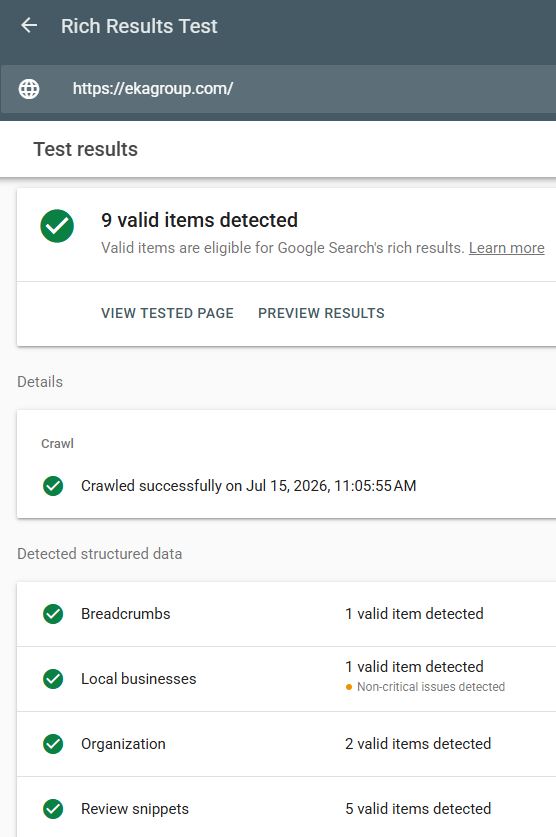
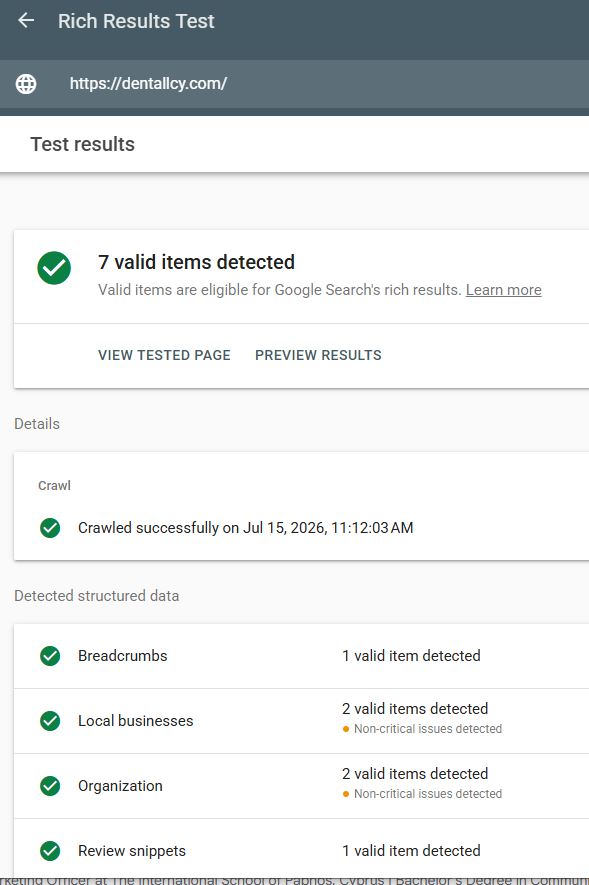
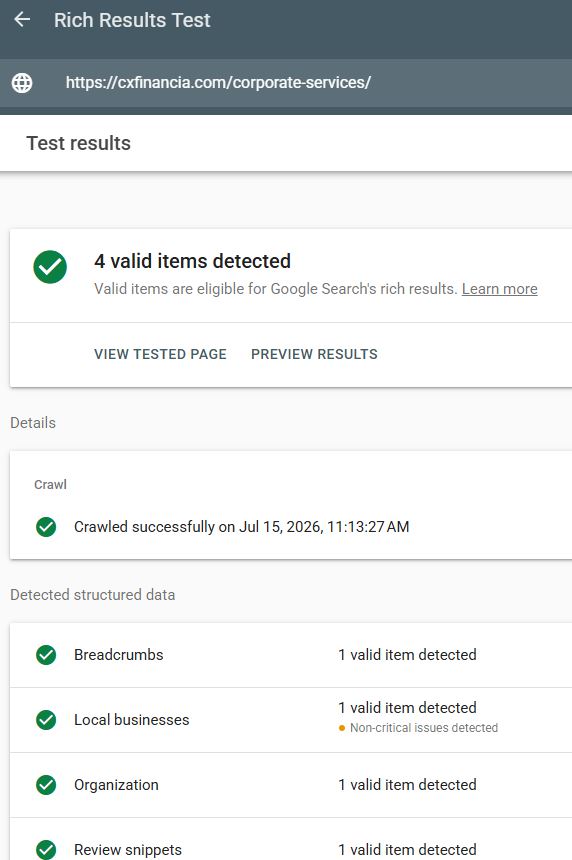
To prove this standard, we run every single launch through Google’s native Rich Results Engine. Across entirely different industries, our technical baseline remains perfectly clean and universally valid:
CX Financia (Corporate Services Page): Implemented an advanced multi-layered schema, generating 4 valid rich tracking elements – explicitly injecting local business registers, organization blueprints, and crucial, live-indexed Review Snippets (breadcrumbs are standard from SEO plugin) to pull corporate authority directly onto the Search Engine Results Page (SERP).
Dentall Clinic: Developed an exhaustive 7 valid rich structural items, successfully anchoring their localized medical authority, organizational data, and patient feedback data streams directly into the core indexing system.
EKA Group: Engineered a massive enterprise-level data layout yielding 9 valid structural entities, featuring 5 distinct, valid Review Snippet systems to maximize their commercial real estate on Google Search.
Before you sign off on a completed website redesign or pay your final agency invoice, do the following steps:
“Before we launch, please provide a CSV export of our 301 redirect map showing that every single indexed page from our old site successfully points to a live page on the new site.”
“Please grant me direct access to our native Google Search Console and GA4 properties. I want to verify our live performance data directly rather than relying on custom PDF summaries.”
“Can you walk me through the integration flow? When a prospect fills out a contact form, show me the exact path the data takes to trigger a notification in our CRM. If that pathway isn’t automated, how are we capturing high-intent intent data?”
Most agencies simply copy-paste text blocks or install generic, automated SEO plug-ins that spit out syntax errors or unparsable items. When Google encounters messy or missing structured data, it entirely drops the site’s rich snippets (like star ratings, corporate logos, and deep sub-links) from search results.
Our work goes down to the microscopic root code of your architecture. By delivering a 100% Green, Validated Rich Results Record for every client, we guarantee that search engines can accurately read your brand’s authority, drive up your click-through rates (CTR), and preserve your search asset value for the long haul. This is the difference between an agency that designs a surface-level layout, and an architecture partner who engineers a highly optimized search engine powerhouse.
At Go Digital Globally, we believe that design enhances user experience, but information architecture and data integrity are what drive business revenue.
We do not hide behind text-heavy essays about “silk approaches” or “subconscious emotional responses.” We prove our value using real, unedited, verifiable data from your own search console.
If you want a partner who treats your website as a high-performing financial asset rather than a cosmetic billboard, let’s build something technically sound together.